If you are planning to buy a compact electric car for daily city commuting in 2026, the Tata Tiago EV and the MG Comet stand out as the two most prominent options. Both vehicles target budget conscious buyers who want to avoid high petrol prices, yet they take completely different approaches to solving the urban mobility problem. Tata recently launched a facelift for the Tiago EV, bringing sharper exterior styling, a redesigned interior, and faster charging capabilities.
MG continues to update the Comet, focusing on its ultra compact footprint and technology heavy cabin. Selecting between a traditional five door hatchback and a quirky two door city car requires you to evaluate your specific driving routes, parking constraints, and passenger requirements. We will examine the exact specifications, real world driving ranges, charging times, and pricing structures of both vehicles to help you make an informed purchase decision.
Exterior Design and Physical Dimensions
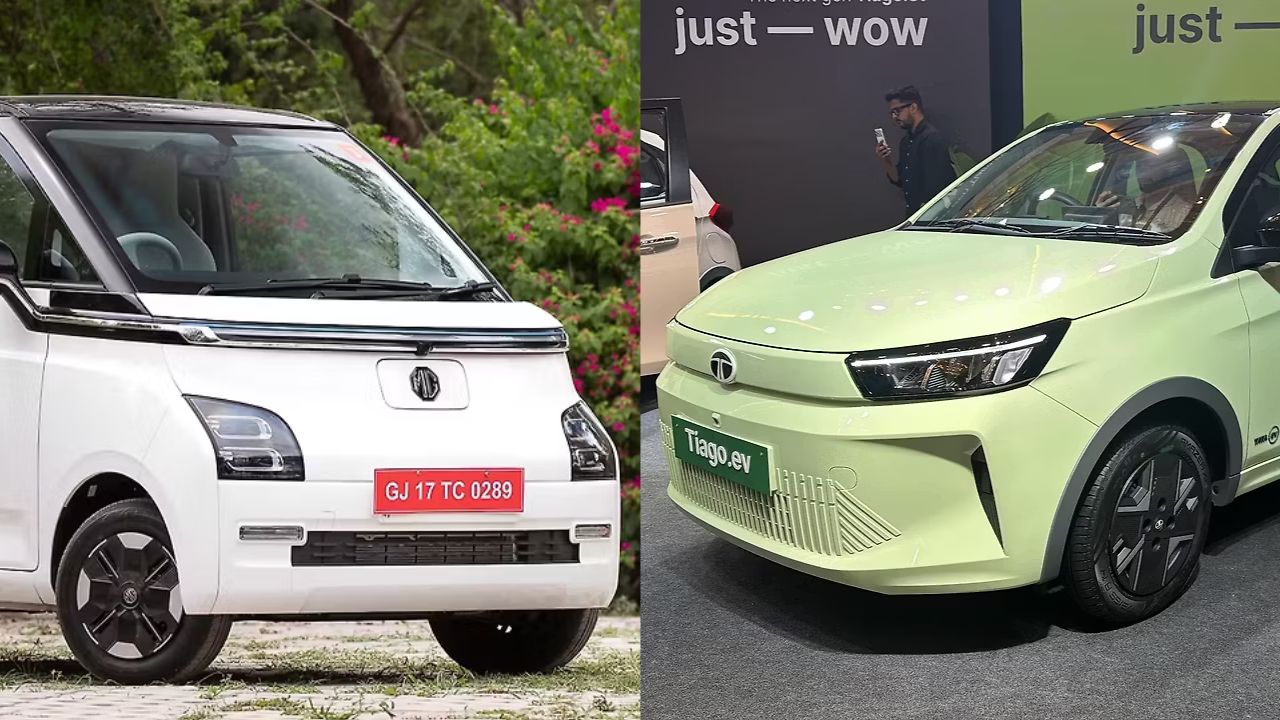
The visual differences between these two electric cars are immediately apparent. The 2026 Tata Tiago EV facelift looks like a conventional modern hatchback. Tata updated the front fascia with connected LED tail lamps and a cleaner, closed off grille area. It retains a standard five door layout, making it instantly familiar to anyone used to driving traditional petrol cars.
The vehicle measures 3769 mm in length, which gives it a substantial presence on the road compared to the Comet. You get standard 14 inch wheels and a choice of several dual tone paint options. The sheet metal feels substantial, and the overall proportions mirror a traditional internal combustion vehicle, allowing it to blend naturally into everyday highway and city traffic.
The MG Comet takes an entirely different design path. It features a boxy, tall boy stance and a two door layout. The Comet measures a mere 2974 mm in length. This ultra compact size makes it exceptionally easy to squeeze into tight parking spots that standard hatchbacks simply cannot fit into. MG gave the Comet an illuminated front logo and a distinctive LED light bar that runs across the front.
The small 12 inch wheels sit pushed all the way out to the corners of the vehicle to maximize interior space. The tall side glass panels provide excellent visibility, which reduces the blind spots considerably when you are maneuvering through congested local markets.
| Dimension | Tata Tiago EV | MG Comet |
| Total Length | 3769 mm | 2974 mm |
| Total Width | 1677 mm | 1505 mm |
| Total Height | 1536 mm | 1640 mm |
| Wheelbase | 2400 mm | 2010 mm |
| Number of Doors | 5 | 2 |
If you have a narrow driveway or struggle to find parking near your office, the MG Comet offers a distinct physical advantage. If you prefer a traditional car design that blends in with other traffic and provides standard road presence, the Tata Tiago EV is the better option.
Interior Layout and Cabin Technology
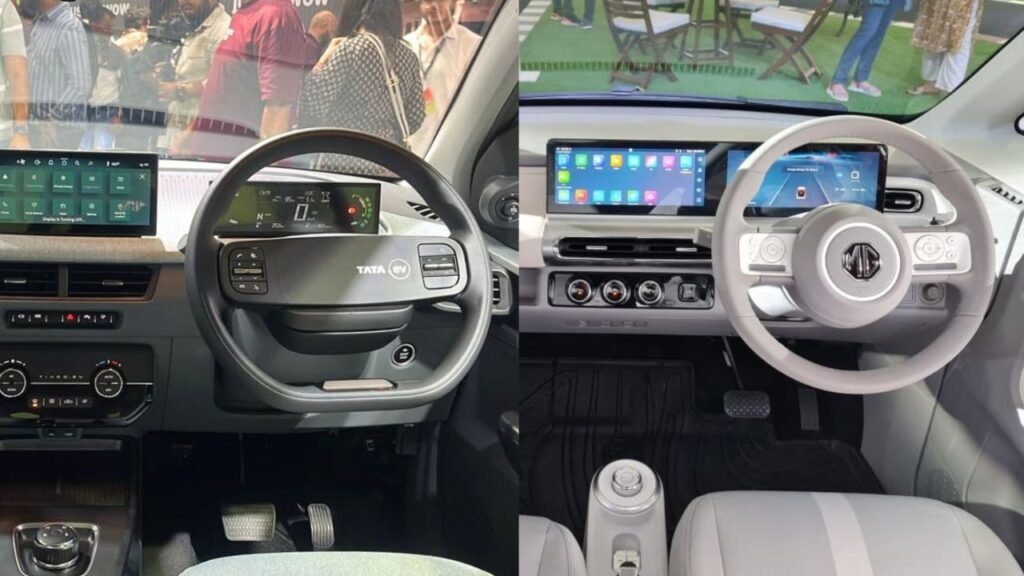
Getting into the Tata Tiago EV feels exactly like stepping into a premium petrol hatchback. The 2026 facelift brings a redesigned dual tone interior layout. You get a central touchscreen infotainment system, physical climate control buttons, and a digital driver display. The five door layout means rear passengers have their own doors for easy access.
The rear seats offer enough legroom for average sized adults, and the boot provides 240 liters of cargo space. You can easily fit a week of groceries or two small suitcases in the back. The seating position is conventional, and the driver controls are exactly where you expect them to be, requiring zero learning curve if you are transitioning from an older vehicle.
The MG Comet focuses heavily on interior technology. Despite its small exterior, the cabin feels surprisingly airy due to the large windows and tall roof. The dashboard is dominated by a floating twin display setup. You get a 10.25 inch digital instrument cluster positioned right next to a 10.25 inch touchscreen infotainment system. This layout mimics the displays found in much more expensive luxury cars. The material choices inside the Comet lean towards bright fabrics and glossy plastics, creating a lounge like atmosphere for the front row occupants.
However, the two door layout of the Comet creates practical limitations for daily use. Rear passengers must fold the front seats forward and climb into the back. The rear seats offer very little thigh support, making them uncomfortable for long trips. The boot space is almost nonexistent when the rear seats are up. You have to fold the 50 50 split rear seats down if you want to carry any meaningful cargo like luggage or larger grocery boxes.
- The Tiago EV provides a traditional five seat layout with dedicated rear doors and a highly usable boot.
- The Comet offers a four seat layout with difficult rear access and prioritizes front row technology over cargo space.
- The Comet features wireless Apple CarPlay and Android Auto across higher variants, while the Tiago EV relies on a standard wired connection on its primary trims.
Battery Specifications and Real World Range
The core of any electric vehicle is its battery pack and realistic driving range. Tata offers the Tiago EV with two different battery options. The standard range version uses a 19.2 kWh battery pack, while the long range version gets a larger 24 kWh battery. Tata claims the 2026 models deliver 226 kilometers and 285 kilometers of range respectively under standard testing conditions.
In real world driving conditions with the air conditioning running, you can expect the larger 24 kWh battery to deliver roughly 200 to 220 kilometers before you need to plug it in. The smaller battery will realistically yield around 160 to 180 kilometers during typical city usage.
The MG Comet keeps things simple with a single 17.3 kWh battery pack across all variants. MG claims an official range of 230 kilometers. When you drive the Comet in heavy city traffic with the climate control active, you will realistically achieve about 170 to 190 kilometers on a single charge. The management software optimizes power usage efficiently at low speeds, ensuring that crawling in bumper to bumper traffic does not drain the battery pack prematurely.
| Specification | Tata Tiago EV | MG Comet |
| Battery Capacity | 19.2 kWh or 24 kWh | 17.3 kWh |
| Claimed Range | 226 km or 285 km | 230 km |
| Realistic Range | 160 to 220 km | 170 to 190 km |
| Motor Power | 60 bhp or 74 bhp | 41 bhp |
| Peak Torque | 110 Nm or 114 Nm | 110 Nm |
If your daily commute exceeds 50 kilometers or you occasionally take short highway trips to neighboring towns, the larger battery options in the Tiago EV provide the necessary peace of mind. The Comet battery capacity limits the vehicle strictly to short daily errands within municipal limits.
Charging Infrastructure and Speeds
Charging capabilities differentiate these two vehicles significantly. The 2026 Tata Tiago EV supports DC fast charging. Tata improved the charging hardware for this facelift. You can now add 100 kilometers of range in just 18 minutes when plugged into a commercial fast charger. If you use a standard 3.3 kW home wall box charger, the larger 24 kWh battery takes about 8.7 hours to charge completely. You also have the option to purchase a faster 7.2 kW AC home charger, which reduces the total charging time to roughly 3.6 hours. This makes the Tiago EV highly adaptable if you need to quickly replenish the battery between chores.
The MG Comet does not support DC fast charging. You cannot plug this car into a public fast charger on the highway. You must rely entirely on AC charging sources. Using a standard 3.3 kW home charger, the Comet takes about 7 hours to reach a full battery from empty. MG does offer an optional 7.4 kW fast AC charger on higher variants, which cuts the charging time down to 3.5 hours. This requires you to install the compatible wall box at your residence or office.
You must consider your personal charging habits closely before choosing. If you plan to charge exclusively at home overnight, the lack of DC fast charging on the Comet will not bother you. If you ever need a quick top up at a public charging station during a busy day, the Tiago EV is the only viable choice between the two.
Driving Dynamics and Urban Usability
Driving an electric vehicle in city traffic provides a smooth and silent experience. The Tata Tiago EV feels planted and stable on the road. The 74 bhp motor in the long range version provides strong acceleration. You can easily overtake slower vehicles on open stretches of road. The suspension absorbs potholes and rough patches effectively. The vehicle drives exactly like a heavy premium hatchback, giving you confidence at higher speeds up to its restricted top speed on the highway. The steering weights up nicely as your speed increases, offering a predictable and reassuring driving feel.
The MG Comet focuses entirely on low speed maneuverability. Its 41 bhp motor provides adequate power for speeds up to 60 kilometers per hour. Beyond that speed, the acceleration drops off noticeably. The top speed is electronically limited to 85 kilometers per hour, making it unsuitable for rapid highway travel. The small 12 inch wheels struggle with large potholes, transmitting sharp bumps directly into the cabin.
However, the Comet excels in heavily congested areas. The turning radius is incredibly tight. You can execute U turns on narrow single lane streets where the Tiago EV would require a multi point turn. The light steering allows you to thread through chaotic traffic with minimal physical effort.
- Choose the Tiago EV if your route includes fast moving ring roads, flyovers, or open highways.
- Choose the Comet if your route consists entirely of heavily congested, narrow city lanes and slow moving market areas.
Safety Equipment and Protective Features
Safety regulations in India mandate specific safety features, and both manufacturers provide essential protective equipment. The 2026 Tata Tiago EV facelift brings major safety upgrades to the compact segment. It now features six airbags as standard across all variants. Tata also added a 360 degree camera system and a blind view monitor. These cameras help you see obstacles around the car when parking. The vehicle includes an anti lock braking system, electronic brakeforce distribution, and tire pressure monitoring. The ZConnect safety suite also allows for remote vehicle tracking and crash notifications.
The MG Comet provides a more basic safety package. It comes with dual front airbags, an anti lock braking system, and electronic stability control. It features a reverse parking camera and rear parking sensors. Because the Comet footprint is so small, you have excellent natural visibility out of the large windows, which helps you avoid low speed scrapes. The frame uses high strength steel, but the vehicle lacks the side and curtain airbags found in the updated Tata hatchback.
| Safety Feature | Tata Tiago EV | MG Comet |
| Airbags | 6 Standard | 2 Standard |
| Parking Cameras | 360 Degree View | Reverse Camera Only |
| Braking System | Front Disc, Rear Drum | Front Disc, Rear Drum |
| Blind View Monitor | Yes | No |
The Tiago EV offers a structurally larger and more comprehensive safety shield if you frequently carry family members through unpredictable city traffic.
Pricing Structures and Final Verdict
Both manufacturers use aggressive pricing strategies to attract budget conscious buyers. Tata launched the 2026 Tiago EV with prices starting at Rs 6.99 lakh for the base 19.2 kWh variant. The fully loaded top variant with the 24 kWh battery costs Rs 9.99 lakh ex showroom. Tata also offers a Battery as a Service scheme. If you opt for this scheme, the upfront cost of the car drops to Rs 4.69 lakh, but you must pay an additional Rs 2.50 for every kilometer you drive to cover the battery rental costs.
The MG Comet starts at a slightly lower price point of Rs 6.31 lakh for the base Executive variant. The top tier Exclusive variant costs Rs 8.68 lakh ex showroom. MG also offers promotional pricing and battery rental options that can bring the initial purchase price down closer to Rs 4.99 lakh, depending on current dealership offers and the specific trim selected.
You should buy the Tata Tiago EV if you want a primary household car. It provides the practicality of four doors, a usable boot, and a suspension system capable of handling bad roads. The inclusion of DC fast charging gives you the flexibility to travel outside your immediate city limits occasionally. The new six airbag setup makes it the safer choice for transporting your family.
You should buy the MG Comet if you need a secondary vehicle strictly for short city errands. If your primary pain point is finding parking in crowded markets, the ultra compact dimensions of the Comet solve that problem perfectly. The dual screens give the cabin a premium, futuristic feel that appeals to tech savvy drivers. As long as you accept the lack of boot space and the inability to use public fast chargers, the Comet serves as an excellent, highly maneuverable city tool.