The TVS Orbiter enters the Indian electric scooter market as a direct answer to the growing demand for affordable, family-oriented battery mobility. TVS designed this vehicle to deliver practical range, substantial storage, and modern connectivity without inflating the price tag. Buying an electric scooter often forces consumers to choose between an expensive high-performance model or a cheap, poorly constructed alternative.
The Orbiter targets the middle ground, providing a reliable build quality and adequate daily specifications. With two distinct variants, the V1 and the V2, the manufacturer caters to both short-distance commuters and those requiring a longer riding range. Understanding the specifications, physical dimensions, and battery options of this scooter will help you decide if it fits your daily transit requirements.
Minimalist Aerodynamic Design and Bold Aesthetics
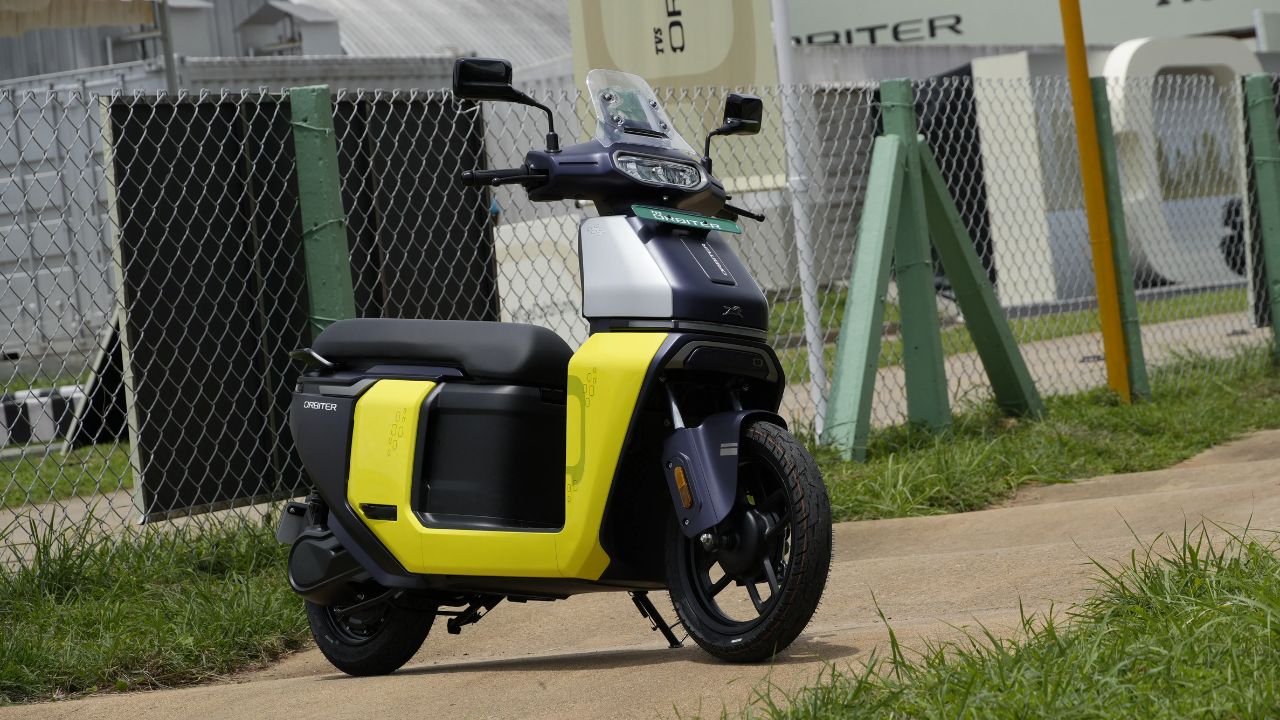
TVS opted for a highly distinctive, square-shaped aesthetic for the Orbiter. The manufacturer calls this a straight-line design approach. Every edge and panel is shaped to maximize aerodynamic efficiency, which TVS claims improves the total riding range by up to 10 percent. The front fascia features a wide, upright flyscreen and an edge-to-edge LED light bar that houses the turn indicators. Below this, crystal LED headlamps project a wide beam for excellent night visibility.
The scooter uses a larger 14-inch alloy wheel at the front and a standard 12-inch alloy wheel at the rear. This staggered wheel setup gives the vehicle a slightly taller front stance, improving stability over rough patches. You can select from six exterior paint finishes: Martian Copper, Cosmic Titanium, Stratos Blue, Stellar Silver, Lunar Grey, and Neon Sunburst. The build quality remains robust, though you will notice a few cost-cutting measures. Several mounting nuts on the front windshield and the floorboard remain exposed without plastic cover caps.
Battery Options and Real-World Range Estimates
The core difference between the two Orbiter variants lies in their battery packs. The base V1 model carries a 1.8 kWh lithium-ion battery. This pack delivers an Indian Driving Cycle (IDC) claimed range of 86 kilometers on a single charge. The premium V2 model upgrades to a 3.1 kWh battery pack, which increases the claimed range to 158 kilometers.
In real-world traffic conditions, you should expect the V1 to cover roughly 65 to 70 kilometers before requiring a plug-in. The larger V2 will comfortably yield about 120 to 130 kilometers of actual riding range. Both battery packs carry an IP67 rating, meaning they are highly resistant to water and dust. You can safely ride the scooter through heavy monsoon rain and standard waterlogged streets. If your daily commute stays under 20 kilometers, the V1 provides sufficient capacity. If you travel across the city frequently or prefer to charge the scooter only once or twice a week, the V2 is the necessary choice.
| Specification | TVS Orbiter V1 | TVS Orbiter V2 |
| Battery Capacity | 1.8 kWh | 3.1 kWh |
| Claimed Range (IDC) | 86 km | 158 km |
| Estimated Real-World Range | 65 – 70 km | 120 – 130 km |
| Battery Type | Lithium-ion | Lithium-ion |
| Protection Rating | IP67 | IP67 |
Motor Specifications and Handling Dynamics
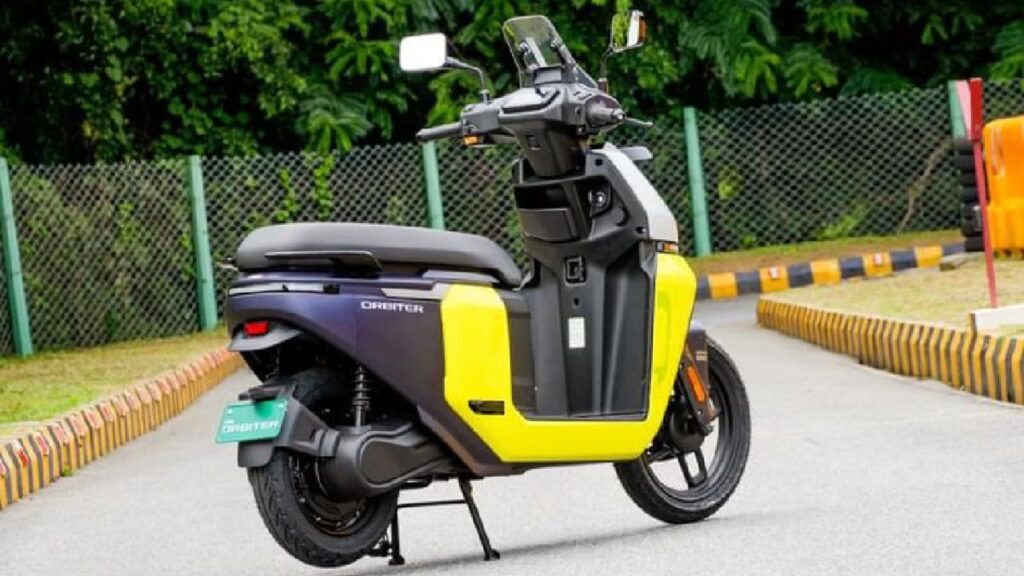
TVS equips the Orbiter with a hub-mounted electric motor. The peak power output reaches 4.4 kW, which propels the scooter to a top speed of 68 kilometers per hour. You get two distinct riding modes: Eco and City. Eco mode restricts the top speed and softens the acceleration to conserve battery life. City mode delivers the full power output, allowing the scooter to accelerate from zero to 40 km/h in 6.8 seconds.
This performance profile perfectly suits dense urban traffic. The top speed is adequate for city limits, but the Orbiter is completely unsuited for fast-moving interstate highways. The suspension system consists of a telescopic front fork and twin rear shock absorbers. The 14-inch front wheel plays a crucial role in the ride quality. It rolls over potholes and large speed breakers with far less steering deflection than traditional 10-inch or 12-inch scooter wheels. The scooter uses drum brakes on both the front and rear wheels, paired with a Synchronized Braking System (SBS) that distributes the braking force to prevent skidding during sudden stops.
Connected Technology and Safety Features
The cockpit features a 5.5-inch color LCD cluster. The display provides essential ride data clearly, though the peak brightness struggles slightly under direct mid-day sunlight. The switchgear feels tactile and responsive, allowing you to navigate the menus without taking your eyes off the road. The Orbiter integrates deeply with the TVS SmartXonnect mobile application. Once you pair your smartphone via Bluetooth, the LCD cluster displays incoming calls, SMS alerts, and turn-by-turn navigation arrows.
Safety technology forms a major part of the Orbiter package. The scooter includes an automatic hill-hold assist function. If you stop on an incline, the system holds the brakes for a few seconds, giving you time to twist the throttle without rolling backward. A reverse park assist mode limits the speed to a slow crawl backward, helping you pull the scooter out of tight parking spaces.
- Distance-to-Empty (DTE): Calculates your remaining range based on your current throttle usage.
- Live Location Tracking: Allows you to monitor the physical location of the scooter remotely.
- Geofencing Alerts: Sends an instant notification to your phone if the scooter leaves a pre-defined geographic boundary.
- Crash/Fall Alert: Automatically cuts power to the hub motor and sends an SMS with your location to emergency contacts if the vehicle tips over.
- Remote Battery Status: Lets you check the state of charge directly from your smartphone.
Comfort, Storage, and Practical Usability
TVS engineered the Orbiter to handle daily household tasks efficiently. The standout physical feature is the massive 34-liter under-seat storage boot. This compartment is wide enough to hold two half-face helmets simultaneously. It lacks deep vertical space, but it easily swallows flat items, laptop bags, and heavy grocery loads. You also get a small open storage box behind the front apron, positioned directly next to a standard USB charging port.
The ergonomics favor riders of all sizes. The flat seat measures 845 mm in length, providing ample room for both the rider and a pillion passenger. The pillion rider receives a sturdy rear grab rail and dedicated footrests integrated neatly into the bodywork, ensuring comfort on longer city trips. The seat height sits at an accessible 760 mm, allowing shorter riders to plant both feet firmly on the ground at traffic lights.
The straight-line footboard is 290 mm wide, offering massive legroom and space to carry large boxes between your feet. The V1 model has a kerb weight of 101 kg, and the V2 weighs 112 kg. This light physical weight makes the scooter incredibly easy to maneuver through heavy, slow-moving traffic.
Charging Infrastructure and Refueling Times
The TVS Orbiter relies entirely on standard alternating current (AC) charging. The scooter does not support DC fast charging. You cannot plug this vehicle into commercial rapid chargers found on highways. You must charge the battery using a standard 15-amp wall socket at your home or workplace. The charger unit itself is portable and fits securely inside the under-seat storage, allowing you to carry it easily if you need to plug in at your office.
The charging times vary significantly between the two battery sizes. The 1.8 kWh battery in the V1 model charges from zero to 80 percent in exactly 2 hours and 20 minutes. A full charge takes roughly three hours. The larger 3.1 kWh battery in the V2 model requires 4 hours and 10 minutes to reach a complete 100 percent charge from empty. A full charging cycle for the V2 consumes approximately 1.8 to 2 units of household electricity. You should establish a dedicated charging routine, plugging the scooter in overnight to ensure maximum range availability the following morning.
Pricing Strategies and Battery as a Service Model
TVS prices the Orbiter aggressively to compete with both petrol scooters and budget electric alternatives. The V1 model carries an ex-showroom price of roughly Rs. 91,550. The top-tier V2 model sits at an ex-showroom price of Rs. 1,13,050. These prices include the standard portable charger.
TVS also offers a highly compelling Battery-as-a-Service (BaaS) purchasing model for the base V1 variant. If you opt for the BaaS plan, the upfront cost of the scooter drops drastically to approximately Rs. 49,999. In exchange for this low initial purchase price, you must pay a battery rental subscription fee of Rs. 1.20 per kilometer driven. You should carefully review the warranty terms on the BaaS model, as the battery ownership remains with the manufacturer.
This model drastically lowers the entry barrier for electric vehicle ownership. You pay for the battery strictly based on your actual usage. If you buy the scooter on a tight budget but intend to ride heavily every day, you must calculate whether the daily per-kilometer rental fee eventually exceeds the standard upfront purchase price.
| Variant | Purchasing Model | Ex-Showroom Price | Ongoing Battery Fee |
| Orbiter V1 | Battery as a Service (BaaS) | Rs. 49,999 | Rs. 1.20 per km |
| Orbiter V1 | Standard Purchase | Rs. 91,550 | None |
| Orbiter V2 | Standard Purchase | Rs. 1,13,050 | None |
- Advantage: Massive 34-liter under-seat storage easily accommodates daily family errands.
- Advantage: The 14-inch front wheel provides superior stability over broken tarmac and potholes.
- Advantage: The Battery-as-a-Service option makes the initial purchase extremely affordable.
- Disadvantage: Complete lack of DC fast charging limits the scooter strictly to planned city commutes.
- Disadvantage: The 68 km/h top speed feels inadequate on wide, fast-moving ring roads.