India’s commercial EV sector has been full of promises. But a 15-minute charge claim on a three-wheeler that’s worth pausing on. Here’s what the Atul Auto–Exponent Energy partnership actually means for drivers and fleet operators.
Why This Announcement Is Daifferent
Electric three-wheelers in India have been stuck in a slow-charge rut. Most CNG-replacement EVs on the market today take 4–8 hours on a standard charger, or 1-2 hours with a DC fast charger both a non-starter for a driver doing 12-hour shifts in cities like Delhi or Bengaluru.
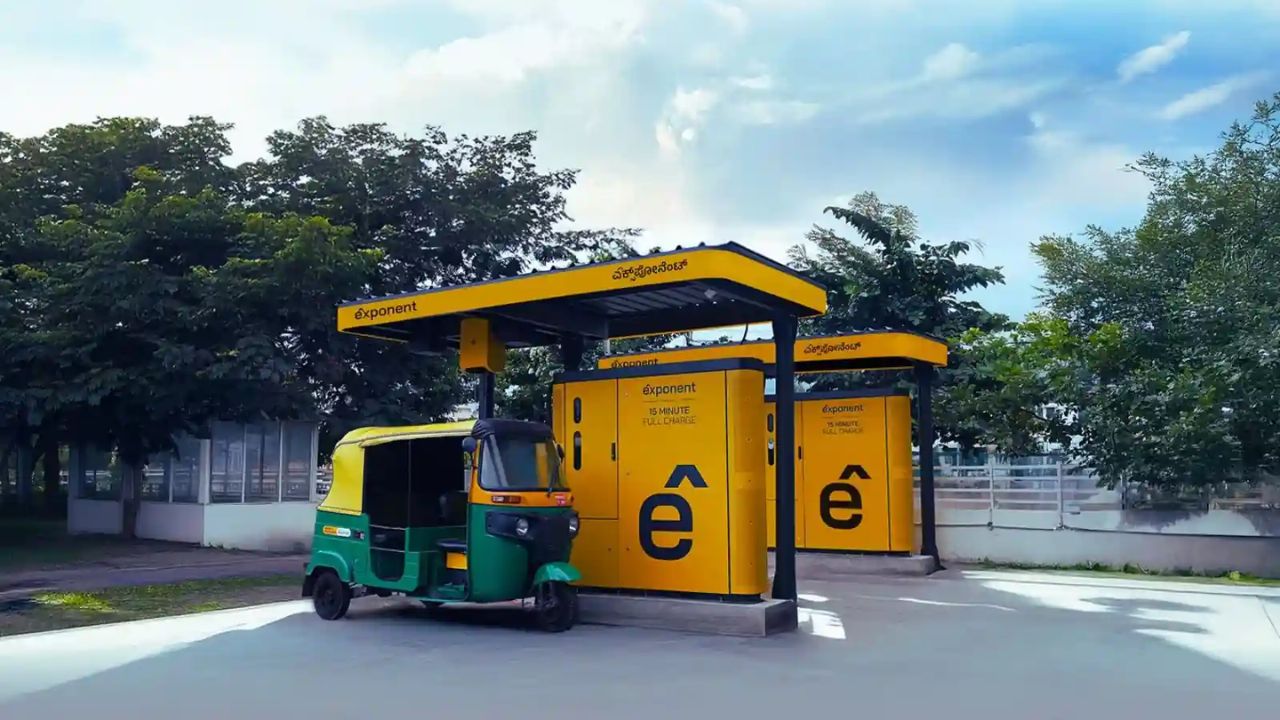
Exponent Energy’s pitch is different, its OTO platform claims a full charge in 15 minutes, using standard lithium-ion cells rather than exotic chemistries. That’s closer to a CNG refill time than any EV product in this segment. If it holds up in real-world deployment, it changes the calculus entirely for commercial operators.
Atul Auto one of India’s most recognised three-wheeler names, with nearly 1 million vehicles on road and exports to 20+ countries adds the credibility of scale. This isn’t a garage startup making big claims; it’s a ₹600 crore-plus manufacturer putting its name on the line.
OTO Platform Explained
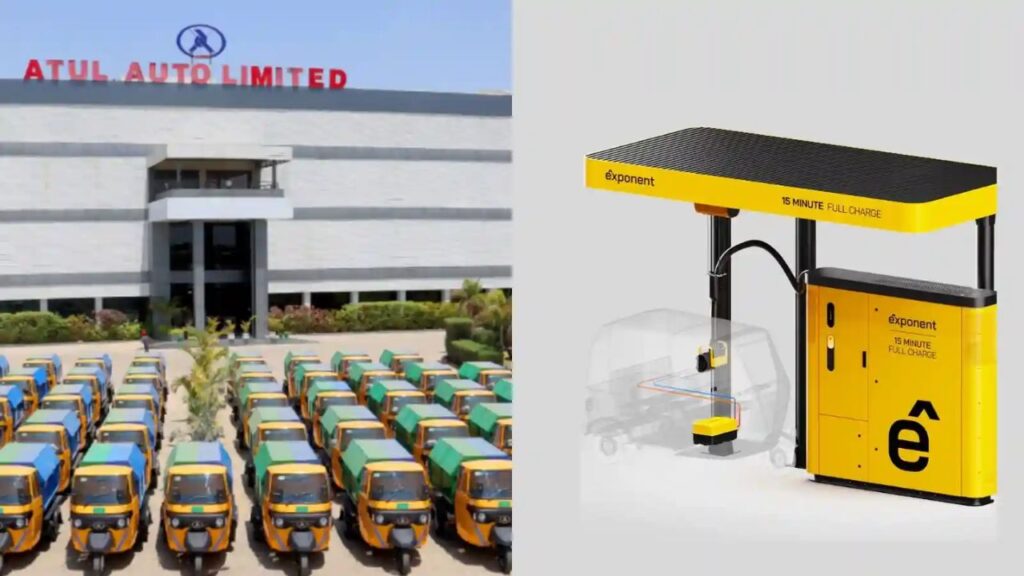
Exponent’s OTO platform is a fully integrated stack battery pack, powertrain, and vehicle software all developed in-house. The company says it achieves 15-minute charging using standard NMC lithium-ion cells by optimising thermal management and charge curve at the system level, rather than at the cell level.
Previously, the platform was tested through retrofit deployments fitting it into existing vehicles. The Atul Auto partnership marks the first time OTO will be integrated directly into a purpose-built OEM vehicle from the ground up. That integration-first approach should improve efficiency and reliability compared to retrofit.
But We’re Skeptical, As Exponent’s 15-minute claim has been demonstrated in controlled conditions, and the company has raised $44.6 million from credible investors including Lightspeed and TDK Ventures. But real-world charging performance depends heavily on grid quality something that’s highly variable across Indian cities and towns. A 15-minute charge at an Exponent fast-charging hub in Bengaluru is not the same as a 15-minute charge in a tier-3 city. We’ll need to see deployment data before calling this claim fully verified.
Key Specs at a Glance
Note: Full vehicle specs pending official launch. Below reflects known platform capabilities and estimated figures.
| Parameter | Detail |
|---|---|
| Charging Time (Full) | 15 minutes (Exponent fast charger) |
| Battery Warranty | 2,00,000 km |
| Standard Charging | Compatible (public + home) |
| Platform | Exponent OTO (integrated battery + powertrain + software) |
| Cell Type | Standard lithium-ion (NMC) |
| Manufacturer Backing | Atul Auto – 300+ service centres, 25 states |
| Financing | Exponent One – insurance, buyback, EMI (pricing TBD) |
| Deployment Target | 15,000 vehicles over 3 years |
| Price | Not disclosed yet |
Does the Math Work for an Auto Driver?
The commercial case for EVs in the three-wheeler space ultimately boils down to earnings per shift, not idealism. Let’s stress-test the key claims.
On the 15-minute charge
A typical auto-rickshaw driver runs 150–200 km per day across 10 -12 hours. With a conventional EV requiring 6-8 hours of charging, a driver either starts the day half-charged or charges while sleeping both limiting options. A 15-minute fast charge can slot into natural breaks (meals, passenger lulls), essentially eliminating downtime as a reason to avoid EVs. This is genuinely compelling if the charging network density scales alongside the vehicles.
On the 2 lakh km battery warranty
At 150 km per day, a commercial driver would hit 2 lakh km in roughly 3.6 years – aligning with a typical ownership cycle. This warranty is directly targeted at the #1 barrier to EV adoption among commercial operators: fear of battery degradation and resale loss. It’s a smart move, not just a number on a press sheet.
On range
Exponent hasn’t disclosed battery capacity or official range yet. As a rule of thumb, expect real-world range to be 25–35% below any IDC-certified claim, standard for Indian EVs across all segments. For a commercial passenger three-wheeler, a realistic daily range target of 120-150 km (usable, accounting for charging stops) is the minimum bar for viability. We’ll reserve judgment until the spec sheet is out.
Competitor Comparison
The EV three-wheeler passenger segment is crowded, but few players offer fast-charging at this level. Here’s how the landscape looks:
| Model | Approx. Price | Charging Time | Range (Claimed) | Key Strength |
|---|---|---|---|---|
| Atul Auto + Exponent OTO | TBD | 15 min (fast) | TBD | Ultra-fast charge + OEM integration |
| Mahindra Treo / Zor Grand | ₹3.5–5.5L (ex-showroom) | 3.5 hrs (fast) | 170 km | Established brand, wide service network |
| Piaggio Ape E-City | ₹3.8–4.8L | 4 hrs | 125 km | Italian engineering, fleet experience |
| Euler HiLoad EV (cargo) | ₹4.5–5L | 4 hrs | 151 km | High payload, cargo focus |
| OSM Rage+ (fleet) | ₹3.5–4.2L | 3–4 hrs | 130 km | Fleet-oriented pricing |
On pure charging speed, Exponent has no real rival in this segment. The question is whether the final pricing will be competitive with Mahindra’s established ecosystem and Piaggio’s service depth.
Who Should Consider This And Who Should Wait
This makes sense for:
Fleet operators running multi-shift operations, where vehicle utilisation is everything. The 15-minute charge and 2 lakh km warranty directly address their pain points. Drivers in cities where Exponent’s fast-charging network is already deployed (primarily Bengaluru today). Owner-drivers who want CNG-comparable convenience without CNG price volatility.
Worth waiting if you are:
A driver in a smaller city or town where the Exponent fast-charging network may not reach for another 12–18 months. Or if you need pricing clarity first if the vehicle costs significantly more than a Mahindra Treo, the total cost of ownership calculation changes. Also, Atul Auto’s EV track record is less established than Mahindra or Piaggio, early adopters will effectively be beta testers.
Frequently Asked Questions
1. What is Exponent Energy’s 15-minute EV charging, is it actually possible?
Yes, Exponent Energy has demonstrated 0-100% charging in 15 minutes using its OTO platform with standard NMC lithium-ion cells. The key is system-level thermal and charge curve optimisation. However, achieving this requires Exponent’s proprietary fast-charging infrastructure, standard home or public chargers will take significantly longer.
2. When will the Atul Auto–Exponent Energy EV three-wheeler launch in India?
No official launch date has been announced yet. The partnership targets 15,000 vehicles over three years, suggesting phased rollout beginning likely in 2026-27. Pricing and full specs are yet to be disclosed.
3. How does Exponent Energy’s OTO platform compare to other EV three-wheelers in India?
No current production EV passenger three-wheeler in India matches Exponent’s 15-minute fast-charge claim. Competitors like Mahindra Treo and Piaggio Ape E-City require 3.5–4 hours on a fast charger. The difference in charging speed is substantial for commercial operators running multiple shifts.
4. Is Atul Auto a reliable EV manufacturer?
Atul Auto is a well-established three-wheeler manufacturer with nearly 1 million vehicles on road globally and over 300 service centres in India. However, its EV portfolio is still in early stages compared to Mahindra or Piaggio. The Exponent partnership is effectively Atul Auto’s most significant EV push to date making this a watch-and-evaluate situation rather than a proven track record buy.
5. What is Exponent One financing for EV three-wheelers?
Exponent One is Exponent Energy’s financing arm, offering embedded insurance, structured buyback options, and flexible EMI plans specifically for commercial EV operators. It aims to reduce the upfront financial barrier of switching from CNG or conventional EVs to Exponent-powered vehicles. Specific interest rates and terms have not been disclosed.