For over a century, the automobile has been a symbol of freedom, engineering ingenuity, and personal expression. Yet, for all the advancements in aerodynamic styling, infotainment technology, and safety suites, the core experience of driving still comes down to a fundamental mechanical choice: how power travels from the engine to the wheels. This is the domain of the transmission. It serves as the vital intermediary that matches the engine’s power characteristics with the vehicle’s speed and load requirements.
For driving enthusiasts, commuters, and prospective car buyers alike, the debate between manual and automatic transmissions is a long-standing one. Each system represents a fundamentally different philosophy of vehicle control, mechanical engineering, and driving engagement. To truly appreciate how these systems impact daily driving, maintenance costs, and fuel efficiency, one must peer beneath the transmission tunnel and explore the intricate mechanics, operational nuances, and historical evolution of both systems.
The Mechanical Foundation of Automotive Transmissions
At its most basic level, an internal combustion engine has a limited operational range known as the powerband, where it produces usable horsepower and torque efficiently. If a car were permanently connected to the engine in a single gear, it would either lack the torque required to move from a standstill or quickly over-rev and self-destruct at highway speeds. A transmission solves this dilemma by changing the gear ratios between the engine’s crankshaft and the drive wheels, allowing the engine to stay within its optimal operating sweet spot regardless of vehicle speed.
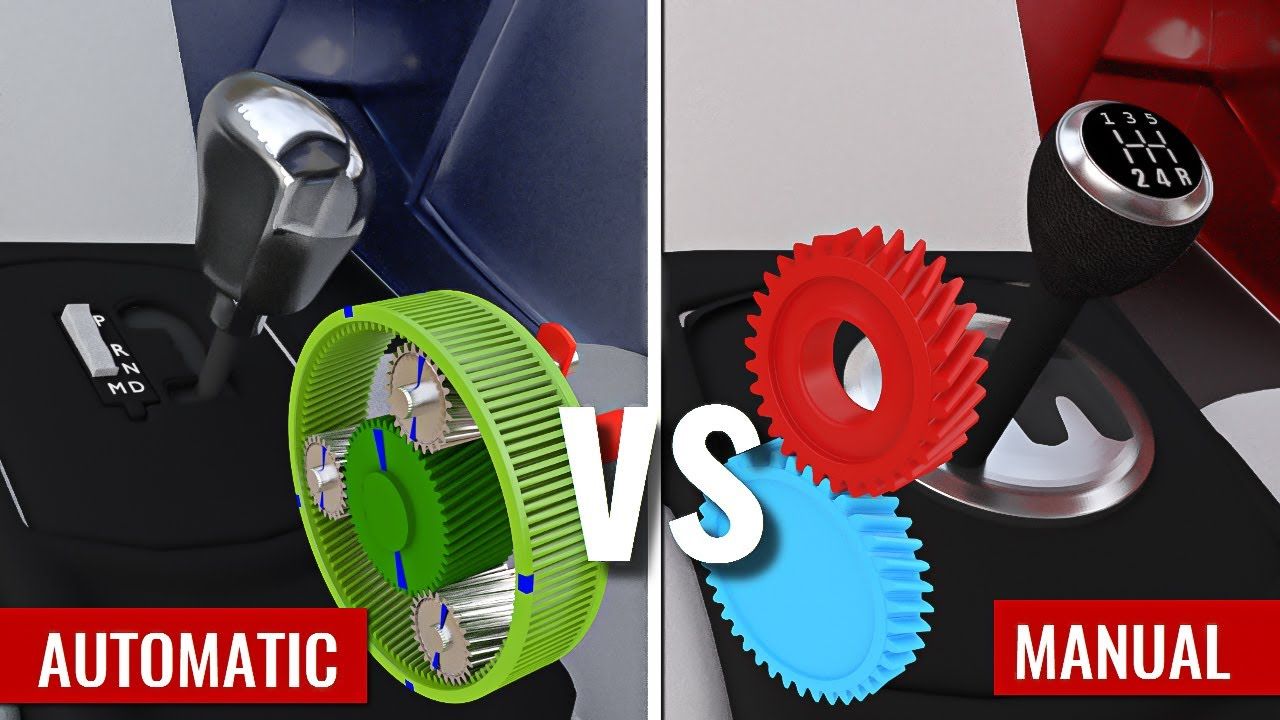
The manual transmission represents the traditional, purely mechanical approach to this engineering challenge. Often referred to as a “stick shift,” a manual gearbox relies on a physical clutch assembly and a driver-operated gear lever. When the driver presses the clutch pedal, a pressure plate releases its grip on the clutch disc, temporarily disconnecting the engine from the transmission. This break in power allows the driver to manually slide gear sets into alignment using the gear shifter before releasing the pedal to re-engage power.
Conversely, an automatic transmission automates this entire process, eliminating both the clutch pedal and the need for manual gear selection. Instead of a mechanical clutch, traditional automatic transmissions rely on a fluid-filled coupling known as a torque converter. The torque converter uses hydraulic pressure to transfer rotational energy from the engine to the transmission gears. Modern automatics also utilize sophisticated electronic control units (ECUs) and complex hydraulic valve bodies to determine the precise moment a gear change should occur based on throttle position, vehicle speed, and engine load.
Decoding the Anatomy of a Manual Transmission
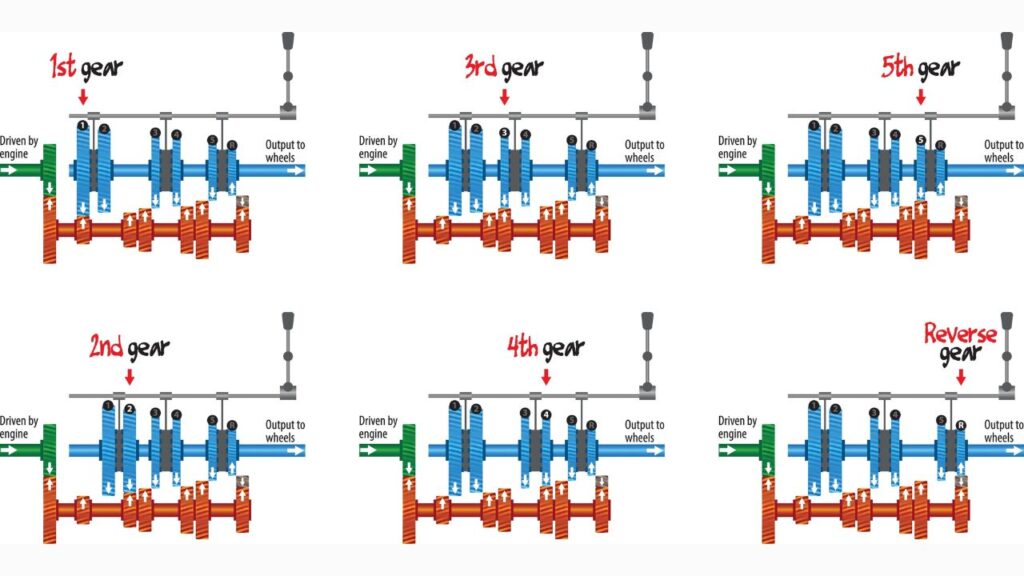
To appreciate the manual transmission, one must understand the brilliant mechanical dance occurring beneath the shifter. Inside a manual gearbox layout, three primary shafts work in tandem: the input shaft, the countershaft (or layshaft), and the output shaft. The input shaft brings rotational energy directly from the engine via the clutch. This energy is transferred to the countershaft, which features a series of gears of varying sizes permanently meshed with gears on the output shaft.
Interestingly, the gears on the output shaft spin freely on bearings and do not directly drive the wheels until they are locked into place. This locking mechanism is achieved through components called synchronizers (or synchros) and slider sleeves. When a driver selects a gear, the shift fork moves a slider sleeve toward the chosen gear.
The synchronizer acts as a mechanical brake, using friction to match the rotational speed of the output shaft gear with the speed of the slider sleeve. Once the speeds are perfectly synchronized, the teeth on the sleeve lock into the gear, completing the physical connection and sending power down the driveshaft to the wheels. This precise friction-matching is what prevents the gears from grinding during a shift, ensuring a smooth transition of power.
The Complex Engineering of Automatic Transmissions
If manual transmissions are a masterclass in elegant mechanical linkages, automatic transmissions are marvels of hydraulic and planetary engineering. Traditional automatics do not use pairs of parallel gears on shafts. Instead, they rely on a compact, concentric gear arrangement known as a planetary gear set.
A single planetary gear set consists of a central “sun gear,” multiple surrounding “planet gears” held by a planetary carrier, and an outer ring gear with internal teeth. By using internal hydraulic clutches and brake bands to lock or release different components of this planetary system, the transmission can achieve multiple forward gear ratios, a neutral gear, and a reverse gear from a single, tightly packed unit.
The hydraulic fluid within an automatic transmission serves multiple critical roles simultaneously. It acts as the working fluid inside the torque converter to transfer power, fills hydraulic circuits to apply pressure to internal clutches, and lubricates and cools the tightly packed components. The shift timing is orchestrated by a valve body, essentially a hydraulic maze that directs fluid to specific clutches. In modern vehicles, this valve body is governed by solenoids controlled by the vehicle’s computer, allowing for rapid, adaptive gear shifts that adjust to a driver’s individual behavior.
Operational Dynamics and Driving Experience
The choice between a manual and automatic transmission fundamentally alters how a human interacts with a machine. Driving a manual vehicle is an active, multi-sensory experience that demands the driver’s full attention and physical coordination. It requires developing a deep muscle memory to balance the engagement point of the clutch with the application of the accelerator, a process that can be intimidating for novice drivers, particularly when starting on steep inclines.
However, for those who master it, the manual gearbox offers an unparalleled level of driver engagement and mechanical connection. The driver can anticipate the road ahead, downshifting early before a corner to stay in the heart of the engine’s powerband, or short-shifting early to maximize fuel economy in a quiet neighborhood. There is an undeniable satisfaction in executing a perfectly rev-matched downshift, where the engine and transmission sing in perfect harmony.
In stark contrast, automatic transmissions prioritize comfort, convenience, and effortless operation. The driving experience becomes significantly less taxing, freeing the driver to focus purely on steering, braking, and monitoring traffic conditions. In bumper-to-bumper city traffic or grueling daily commutes, the elimination of constant clutch modulation removes a massive source of physical fatigue.
Furthermore, modern multi-speed automatics (ranging from 8 to 10 speed variations) shift with a speed and precision that no human driver can replicate, offering seamless acceleration that makes the transitions between gears nearly imperceptible to the vehicle’s passengers.
Comparing Efficiency, Performance, and Maintenance
Historically, manual transmissions held a massive advantage over automatics in both fuel efficiency and raw performance. Early automatic transmissions were limited to three or four speeds, suffered from significant energy loss due to fluid slippage within the torque converter, and added considerable weight to the vehicle. Manuals, with their direct mechanical locking mechanism and lighter weight, easily extracted more miles out of every gallon of fuel.
However, the automotive engineering landscape has shifted dramatically over the past two decades. Modern automatic transmissions have evolved to feature advanced lock-up torque converters that eliminate fluid slippage at cruising speeds, alongside electronic tuning optimized for maximum efficiency. With access to eight, nine, or even ten gear ratios, modern automatics can keep the engine running at its absolute lowest, most efficient RPM during highway cruising, often outperforming their manual counterparts in official EPA fuel economy ratings.
When it comes to maintenance and long-term reliability, the manual transmission still holds an advantage due to its relative simplicity. A manual gearbox contains far fewer moving parts, generates less internal heat, and relies on simple gear oil that rarely requires changing compared to the complex fluid flush schedules of an automatic.
The primary wear item in a manual system is the clutch disc itself, which will eventually need replacement depending on driving habits. Conversely, when an automatic transmission suffers an internal mechanical or electronic failure, the repair process is highly complex, often requiring specialized diagnostic tools, intensive labor, and expensive replacement components.
Quantifying the Differences: Transmission Characteristics
To better understand how these two transmission philosophies stack up across various automotive parameters, it is helpful to analyze their primary characteristics side by side. The following data highlights the distinct trade-offs inherent to each system.
| Parameter | Manual Transmission | Automatic Transmission |
| Driver Engagement | Extremely High; complete control over gear selection. | Low to Moderate; minimal physical interaction required. |
| Mechanical Complexity | Low; relies on simple shafts, gears, and synchros. | High; utilizes planetary gears, hydraulics, and electronics. |
| Learning Curve | Steep; requires physical coordination and practice. | Flat; highly intuitive, pick-up-and-go operation. |
| Initial Purchase Cost | Typically lower (where available on base models). | Generally higher due to complex components. |
| Long-term Reliability | High; fewer components prone to catastrophic failure. | Moderate; sensitive to fluid degradation and heat. |
| Primary Wear Component | Friction clutch disc (requires periodic replacement). | Internal clutch packs, torque converter, solenoids. |
Analyzing Performance Metrics and Costs
When purchasing a vehicle or evaluating its long-term total cost of ownership, the implications of the transmission choice extend far beyond the showroom floor. Below is a comparative breakdown evaluating performance, fuel economy trends, and average maintenance expectations over a vehicle’s typical lifecycle.
| Evaluation Metric | Manual Transmission Performance | Automatic Transmission Performance |
| Acceleration Speed | Limited by human physical shift speeds. | Lightning-fast shifts, often faster than human capability. |
| Stop-and-Go Commuting | High driver fatigue; constant pedal modulation. | Effortless; creep capability reduces stress. |
| Towing Performance | Exceptional control over gear retention on grades. | Superior smoothness; high torque handling capabilities. |
| Fluid Service Intervals | Often 60,000 to 100,000 miles (or lifetime fluid). | Typically 30,000 to 60,000 miles for optimal health. |
| Average Repair Costs | Lower; clutch replacement is the primary expense. | Higher; full rebuilds can cost thousands of dollars. |
Key Advantages and Core Disadvantages
To summarize the practical implications of choosing one system over another, we can categorize the defining realities of owning each transmission type. Each configuration appeals to a distinct set of priorities.
The Manual Transmission Reality
- The Pros: Lower upfront vehicle purchase price, lighter overall curb weight, cheaper mechanical repair costs, complete command over engine braking, and an immersive driving experience that prevents distracted driving.
- The Cons: High physical fatigue in heavy city traffic, risk of stalling in critical traffic situations, steeper learning curve for family members, and lower resale value due to a shrinking market of buyers who know how to operate a clutch.
The Automatic Transmission Reality
- The Pros: Exceptional ease of use for drivers of all skill levels, smooth and uninterrupted power delivery, superior performance in modern multi-speed and dual-clutch formats, and seamless integration with advanced safety features like adaptive cruise control.
- The Cons: Higher initial vehicle cost, increased mechanical complexity, susceptibility to overheating under extreme loads, and potential lack of engagement for automotive purists who enjoy the art of driving.
Alternative Transmission Variants
While the debate is often framed as a strict binary choice between a traditional manual and a conventional torque-converter automatic, modern automotive engineering has introduced several hybrid variants that blur the lines between the two systems.
One prominent alternative is the Continuously Variable Transmission (CVT). Unlike a traditional gearbox that uses a fixed set of gears, a CVT utilizes a high-strength steel belt riding between two variable-diameter pulleys. By continuously adjusting the width of the pulleys, the CVT can create an infinite number of gear ratios, keeping the engine running at its absolute peak efficiency at all times. While CVTs offer outstanding fuel economy, they are often criticized by enthusiasts for a disconnected driving feel and a droning engine note during hard acceleration.
Another high-performance alternative is the Dual-Clutch Transmission (DCT). A DCT operates conceptually like two manual transmissions housed within a single casing, working without a traditional torque converter. One clutch handles the odd-numbered gears (1st, 3rd, 5th), while the second clutch controls the even-numbered gears (2nd, 4th, 6th).
As the vehicle accelerates in first gear, the computer pre-selects second gear on the alternating shaft. When it is time to shift, one clutch opens as the other closes simultaneously. This results in gear changes that occur in milliseconds, far faster than any human can shift a manual combining the mechanical efficiency and direct feel of a manual with the lightning-fast automation of a modern racecar.
Making the Final Decision
Ultimately, the choice between a manual and an automatic transmission is deeply personal, rooted in how you view your time spent behind the wheel. If you view a car primarily as an appliance designed to transport you from point A to point B with minimal stress, maximum comfort, and seamless integration into a busy lifestyle, the modern automatic transmission is the undisputed choice. Its technological sophistication, effortless traffic manners, and optimized efficiency make it the perfect companion for the modern daily grind.
However, if you view driving not merely as a chore, but as an opportunity for engagement, focus, and physical harmony with a machine, the manual transmission remains an alluring option. Despite its declining availability in contemporary vehicle lineups, the stick shift offers a timeless, tactile joy that connects the driver to the mechanical soul of the automobile in a way that electronic sensors and hydraulic valves simply cannot replicate. Each system has earned its place in automotive history, representing two distinct paths to engineering excellence on the open road.