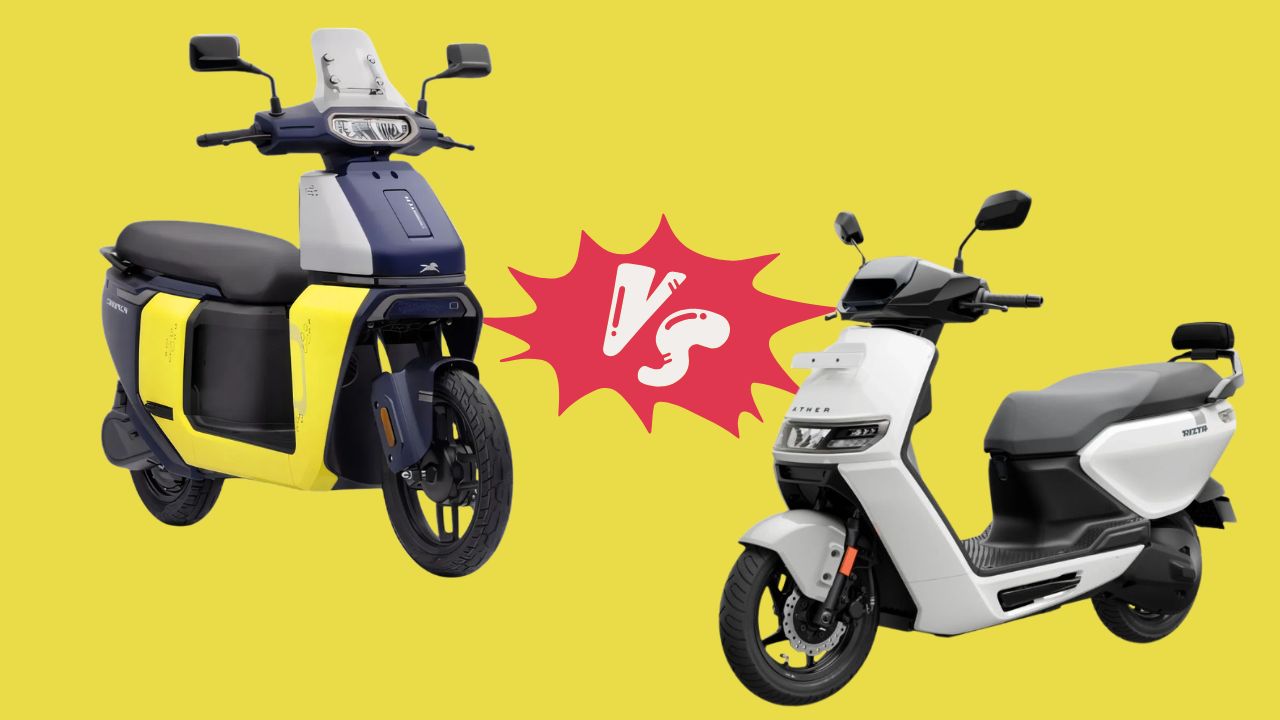
The TVS Orbiter and Ather Rizta are two of the most discussed electric scooters in India in 2026. The TVS Orbiter is a budget-friendly urban commuter with a distinctive boxy design, a 3.1 kWh battery, and a claimed IDC range of 158 km, priced from Rs 88,250 ex-showroom. The Ather Rizta is a family-focused electric scooter with a 7-inch TFT touchscreen, up to 3.7 kWh battery, a claimed IDC range of up to 160 km, and a starting price of Rs 1.15 lakh. Both scooters are aimed at daily urban riders, but they serve different buyer profiles. If you are searching for the best electric scooter under Rs 1.5 lakh, or wondering whether the TVS Orbiter or Ather Rizta is a better buy in 2026, this comparison will give you every answer you need.
Key Specifications Compared
| Specification | TVS Orbiter V2 | Ather Rizta Z 3.7 kWh |
|---|---|---|
| Battery Capacity | 3.1 kWh | 3.7 kWh |
| Claimed IDC Range | 158 km | 160 km |
| Real-World Range | 100 to 115 km | 110 to 125 km |
| Top Speed | 68 km/h | 80 km/h |
| Motor Type | Hub-mounted BLDC | BLDC |
| Under-Seat Storage | 34 litres | 34 litres |
| Seat Height | 760 mm | 780 mm |
| Display | Coloured LCD | 7-inch TFT Touchscreen |
| Charging Time (0-80%) | 4 hours 10 minutes | Approx. 3.5 hours |
| Front Wheel Size | 14 inches (segment first) | 12 inches |
| Ride Modes | Eco and Power | Smart Eco and Zip |
| Hill Hold Assist | Yes | Yes |
| Reverse Mode | Yes (Parking Assist) | Yes |
| Cruise Control | Yes | No |
| OTA Updates | Yes | Yes |
| Starting Price (Ex-showroom) | Rs 88,250 | Rs 1.15 lakh |
| Top Variant Price (Ex-showroom) | Rs 1,04,900 | Rs 1.54 lakh |
| Colours Available | 6 | 9 |
Design and Build: Urban Quirky vs Family Friendly
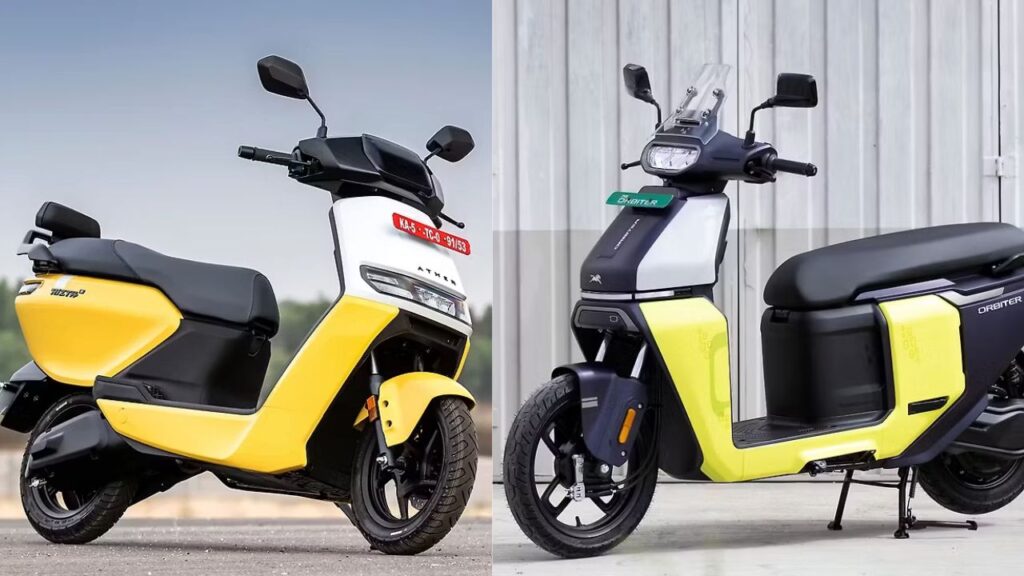
The TVS Orbiter is immediately recognisable on the road. Its boxy, utilitarian design with clean lines, a high-mounted LED headlamp with an integrated visor, and a compact tail lamp gives it a distinctly Gen Z-friendly personality that stands apart from almost everything else in the segment. The 14-inch front wheel is a genuine segment first and not just a talking point: it meaningfully improves stability and comfort over uneven urban roads. Available in six colours including Neon Sunburst, Stratos Blue, and Martian Copper, the Orbiter has a youthful, modern identity. The 845 mm long flat seat and 290 mm straight-line footboard give it comfortable ergonomics for both rider and pillion, and the 760 mm seat height makes it accessible for riders of most heights.
The Ather Rizta takes a different design approach entirely. Its rounded, curvaceous body panels, long dual-tone seat, and pillion backrest are built with family use in mind. The Rizta looks approachable and practical rather than edgy, and its nine available colour options including Alphonso Yellow Duo, Cardamom Green Duo, and Pangong Blue give it a wide range of personalisation choices. The build quality on the Rizta is generally regarded as solid, though some owners in long-term reviews have pointed to the plastic quality on the upper dashboard fading over time with extended exposure to Indian sun.
Both scooters have roughly comparable dimensions and boot space at 34 litres, but the Rizta can be further enhanced with an optional 22-litre frunk accessory, taking total storage potential to 56 litres, a significant practical advantage for families.
Features and Technology: Connected Commuter vs Smart Family Scooter
This is one of the most important areas of differentiation between the two scooters, and the Ather Rizta Z holds a clear advantage in its flagship variant.
Features standard on the TVS Orbiter include:
- Coloured LCD cluster with incoming call alerts
- Turn-by-turn navigation
- Cruise control (a genuine segment rarity at this price)
- Hill Hold Assist and Parking Assist with reverse mode
- Crash alerts, fall detection, anti-theft, geo-fencing, and time-fencing
- OTA updates via SmartXonnect app
- USB charging port
- Edge-to-edge combination lamps and full LED lighting
The Ather Rizta Z variant raises the bar significantly with a 7-inch colour TFT touchscreen that also features on the Ather 450X, bringing a level of display quality rarely seen at this price. The AtherStack 7.0 platform powers AI-based voice commands, pothole alerts in major Indian cities, crash detection, Magic Twist regenerative braking, and WhatsApp messaging integration on the instrument panel. The Rizta Z also receives touchscreen OTA updates, meaning the scooter can receive new features and software improvements wirelessly without a service centre visit.
The Orbiter has one notable feature advantage over the Rizta: cruise control. For riders who spend time on longer stretches of road or expressways, this is a genuine everyday convenience that the Rizta does not offer.
Performance and Range: Who Wins on the Road?
On paper, the two scooters are remarkably close. The TVS Orbiter V2 claims 158 km of IDC range from its 3.1 kWh battery, while the Ather Rizta Z 3.7 kWh claims 160 km. In real-world conditions, both deliver approximately 100 to 125 km depending on riding mode, load, and terrain.
The performance gap is more noticeable when you look at top speed. The Ather Rizta is electronically limited to 80 km/h, while the TVS Orbiter tops out at 68 km/h. For urban commuters, 68 km/h is adequate for most city roads, but the Rizta’s higher top speed gives it more headroom for suburban routes and arterial roads where traffic moves faster.
Riders who have reviewed the Orbiter in real-world conditions report approximately 100 to 115 km of range in mixed city use, which is very practical for daily commutes of up to 50 km. The Rizta’s 3.7 kWh variant delivers slightly better real-world range of 110 to 125 km in mixed conditions. The Orbiter’s charging time of 4 hours 10 minutes for a full charge is longer than ideal, while the Rizta charges to 80 percent in approximately 3.5 hours with the standard charger.
Pros and Cons of Both Electric Scooter
| TVS Orbiter | Ather Rizta | |
|---|---|---|
| Pros | Significantly more affordable, starts at Rs 88,250 | 7-inch TFT touchscreen on Z variant |
| Cruise control is a segment rarity at this price | Higher top speed of 80 km/h | |
| Industry-first 14-inch front wheel improves stability | AI-powered AtherStack 7.0 with voice commands | |
| Distinctive, youthful design stands out | Optional frunk takes storage to 56 litres | |
| Battery-as-a-Service option makes it even more accessible | Skid control and advanced safety features | |
| TVS’s vast dealer and service network across India | 9 colour options including dual-tone choices | |
| Cons | Top speed of 68 km/h is lower than rivals | Starts at Rs 1.15 lakh, notably pricier |
| LCD display lacks the premium feel of a TFT screen | Ather service network smaller than TVS (500 centres) | |
| No disc brake option even as a paid upgrade | Some owners report battery degradation over time | |
| Charging time of over 4 hours is slow | Long seat can be difficult to close due to narrow lock | |
| No skid control or advanced safety electronics | No cruise control on any variant |
Our View: Which Scooter Should You Choose?
The choice between the TVS Orbiter and Ather Rizta ultimately comes down to budget and what you value most in an electric scooter.
The TVS Orbiter is the right choice for buyers who want a well-featured, practical electric scooter with a strong service network and a genuinely accessible price. At Rs 88,250 for the V2 and Rs 1,04,900 for the top variant, it delivers cruise control, hill hold, reverse mode, connected safety features, and a distinctive design that punches well above its price. The 14-inch front wheel, 34-litre boot, and BaaS availability make it an exceptionally smart buy for first-time EV owners and budget-conscious urban commuters. TVS’s nationwide dealer network of over 1,000 touchpoints is also a significant reassurance for after-sales support.
The Ather Rizta is the right choice for buyers who want the most advanced technology experience in a family-oriented electric scooter and are willing to pay for it. The 7-inch TFT touchscreen, AtherStack 7.0 AI features, Magic Twist regenerative braking, skid control, and the optional frunk make the Rizta Z 3.7 kWh variant a genuinely impressive piece of technology for its segment. At Rs 1.15 lakh to Rs 1.54 lakh, it costs meaningfully more than the Orbiter, and Ather’s service network of 500 centres is smaller than TVS’s, particularly in tier 3 and tier 4 cities. But for urban buyers in major cities who want the best features their money can buy in a family scooter, the Rizta Z delivers them.
If budget is the primary consideration: TVS Orbiter. If technology and performance are the priority: Ather Rizta Z.