India’s aggressive push for ethanol-blended fuels presents one of the most critical shifts in our automotive landscape today. The Ethanol Blended Petrol programme has successfully achieved its E20 target ahead of schedule by 2025-26. Now, the government has officially introduced E85 fuel at select dispensing outlets. The new E85 fuel is priced around ₹20 cheaper per litre than standard E20. This ambitious move aims to drastically reduce crude oil imports, support local farmers, lower harmful emissions, and secure national energy resources. However, everyday car buyers still face some very confusing choices at the fuel pump. You might wonder how E20 and E85 truly compare when tested in real-world driving conditions. Is it actually worth your hard-earned cash to invest in a brand new flex-fuel vehicle today? This detailed guide examines verified data from independent tests, government reports, and leading industry sources. We will give you a balanced, completely fact-based analysis without any unnecessary speculation.
The Hidden Mechanics of E20 and E85 Fuels
E20 is basically regular petrol blended perfectly with 20 percent ethanol. This is now the default standard across India since April 2026. This ethanol is primarily produced from sugarcane molasses, with increasing contributions coming from alternative grains like maize. It inherently possess a lower energy density compared to pure, unblended petrol. Ethanol delivers roughly 21 to 24 MJ per litre, while pure petrol offers a robust 32 MJ per litre. Most vehicles manufactured after 2023 with BS6 compliance can safely handle E20 fuel without any catastrophic engine failure. Their components are specifically manufactured using E20-compliant materials.
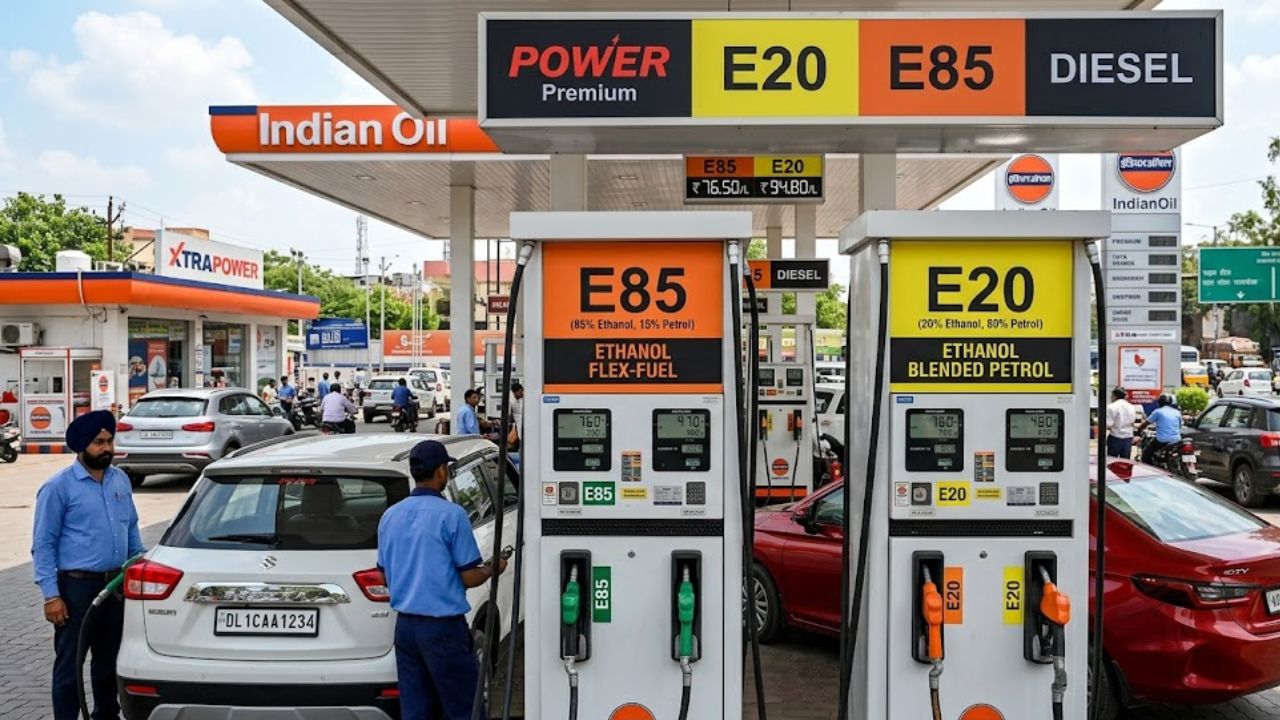
E85 is an entirely different beast altogether. It contains a massive 85 percent ethanol mixed with just 15 percent petrol. It is engineered exclusively for flex-fuel vehicles, which boast heavily modified engines and larger fuel injectors. These special vehicles use ethanol-resistant materials to prevent severe internal corrosion. Their smart sensors adjust ignition timing and fuel delivery automatically based on the exact blend ratio in the tank. Engine duties is handled by a heavily modified control unit that calculates injection times constantly.
You must never pump E85 into a standard petrol car. Regular petrol vehicles simply cannot use E85 safely for long periods, as it severely risks fuel system damage. Using it will cause your engine to run incredibly lean, and rapid component degradation is almost guaranteed. As of mid-2026, E85 is only available at a very limited number of fuel stations. You will find around 48 to 100 outlets initially operating in Delhi-NCR and a few other major transport corridors. The government plans to scale this up to 500 stations by December 2026, and they target 5,000 locations by 2027. In Delhi, E85 was launched at a highly attractive price of approximately ₹82.12 per litre. Standard E20 petrol retails at exactly ₹102.12 per litre in the same city.
The Engineering Marvel Behind Flex-Fuel Hardware
The mechanical engineering behind these flex-fuel engines is genuinely fascinating. A standard petrol engine relies heavily on standard rubber seals and basic fuel lines. When high concentrations of ethanol are introduced, these basic components start breaking down rapidly. Ethanol is highly corrosive and aggressively absorbs water from the atmosphere. To combat this, automotive engineers upgrade the entire fuel delivery pathway with stainless steel components and advanced Teflon-coated hoses. They also install intelligent fuel composition sensors directly into the fuel lines. These sensors continuously analyze the exact ratio of ethanol to petrol flowing towards the engine block. The engine control unit then instantly recalculates the required spark timing and fuel injection duration. This ensures the engine operates smoothly regardless of what blend you just pumped into the tank. This complex hardware is precisely why flex-fuel vehicles carry a noticeable price premium.
The Mileage Shock: Do the Numbers Really Add Up?

The lower calorific value of ethanol inevitably leads to reduced fuel economy. Both official agencies and independent testers confirm this annoying reality. For E20 fuel used in compatible vehicles, the efficiency drop is noticeable but generally manageable. The Automotive Research Association of India estimates a modest 1 to 6 percent drop compared to older E0 or E10 fuels. Most carmakers frankly report a 7 to 8 percent reduction in real-world driving scenarios. Independent tests conducted by leading automotive journalists showed drops ranging from 3.8 percent to 12.6 percent. This averages out to around 6 to 8 percent, depending heavily on your specific car model and driving style. For instance, a Maruti Dzire experienced only a 3.8 percent drop, while a sporty Hyundai Creta N Line suffered a heavier 12.6 percent loss. Older non-E20 compliant vehicles often report much higher efficiency drops, sometimes exceeding 15 percent. These older engines also face potential long-term issues with their sensitive rubber and plastic internal parts.
Many drivers fail to understand the core physics behind fuel combustion. Energy density dictates exactly how much power a specific volume of liquid can generate when ignited. Because ethanol fundamentally lacks the dense hydrocarbon chains found in refined petrol, it simply burns quicker with less force. If you press the accelerator pedal in an E85-powered vehicle, the fuel injectors must physically spray a significantly larger volume of liquid into the cylinders to achieve the desired acceleration. This heavy fuel consumption is what destroys your overall mileage figures. Independent tests conducted by leading magazines like Autocar India clearly demonstrate this painful reality. They meticulously tested multiple popular car models under strict conditions to ensure maximum accuracy. These figure prove that no two engine designs react exactly the same way to ethanol blending. Turbocharged engines, for example, often handle the higher octane rating of ethanol better than older naturally aspirated motors. However, the sheer loss of energy density eventually catches up with every single vehicle type on the road.
The efficiency hit become extremely drastic when you evaluate E85 fuel. A real-world test on the Suzuki Gixxer SF 250 FFV revealed some truly eye-opening numbers. Driven at an average speed of 29 kmph over an 80km loop, the motorcycle delivered 38.1 kmpl on E20 fuel. When filled with cheaper E85 fuel, the mileage plummeted heavily to just 28.81 kmpl. That is a massive 24.4 percent drop in overall efficiency. Broader industry expectations predict a 25 to 35 percent lower efficiency for E85 compared to E20 equivalents. This happens strictly because of the lower energy content packed into E85 fuel. Ethanol literally requires more physical liquid volume to deliver the exact same explosive energy inside the cylinder.
Calculating the True Cost Per Kilometre for Your Wallet
We need to crunch the financial numbers to see if the massive pump discount actually compensates for the terrible mileage. Let us use the current Delhi prices for our calculation, with E20 at ₹102.12 and E85 at ₹82.12. Consider a hypothetical modern car that delivers a respectable 15 kmpl while running on standard E20 petrol. The running cost per kilometre works out to approximately ₹6.81. If this same vehicle ran on E85 and experienced a 25 to 35 percent efficiency drop, the mileage would fall to around 10.5 to 11.25 kmpl. At the cheaper fuel rate of ₹82.12 per litre, your running cost increases to roughly ₹7.30 to ₹7.82 per kilometre.
| Fuel Type | Price Per Litre | Assumed Mileage | Cost Per Kilometre |
| E20 Petrol | ₹102.12 | 15.00 kmpl | ₹6.81 |
| E85 Ethanol | ₹82.12 | 11.25 kmpl (25% drop) | ₹7.30 |
| E85 Ethanol | ₹82.12 | 10.50 kmpl (30% drop) | ₹7.82 |
The exact same financial logic applies to two-wheelers. Taking the Suzuki Gixxer SF 250 test as an example, E20 costs ₹2.68 per kilometre to operate. Switching to E85 pushes that cost up slightly to ₹2.85 per kilometre. Over a total distance of 10,000 kilometres, running on E85 will actually cost you about ₹1,711 more. The generous 19 to 20 percent price discount on E85 sadly does not fully offset the 24 to 35 percent efficiency loss. Running costs are typically higher on E85 under the current pricing structure. For E85 to break even or save money, it would need to be priced significantly lower relative to the massive efficiency gap. Alternatively, vehicles would need highly optimized engine tuning designed specifically for higher ethanol blends. E20’s modest efficiency drop is often partially offset by its higher octane rating, which promotes better combustion in properly tuned engines. This makes E20 perfectly manageable for most daily drivers navigating heavy city traffic.
You must also factor in the hidden costs of potentially shorter maintenance intervals. Ethanol burns cleaner, but its corrosive nature can sometimes accelerate wear on specific engine parts if the vehicle is not adequately prepared. Flex-fuel vehicle owners might find themselves replacing spark plugs or fuel filters slightly more frequently than standard petrol car owners. This subtle increase in maintenance costs eats away at any marginal savings you might achieve at the fuel pump. The current pricing strategy implemented by fuel retailers clearly prioritizes expanding the ethanol market share over delivering immediate financial relief to the end consumer. It is a classic long-term economic play designed to stabilize the national economy first. Until the government decides to aggressively subsidize E85 further, the cost per kilometre will remain stubbornly high. Savvy consumers are already running these complex calculations before stepping foot inside a car dealership.
Are Flex-Fuel Vehicles Actually Available to Buy Today?
Flex-fuel vehicles are currently in the very early stages of market adoption in India. In the two-wheeler segment, you can purchase the Suzuki Gixxer SF 250 FFV for roughly ₹1.98 lakh. This represents a relatively small 5 percent premium over the standard petrol version. Hero MotoCorp recently launched flex-fuel versions of the popular Splendor+ and HF Deluxe, with customer deliveries starting in July 2026. The four-wheeler market is also waking up to this new technology. Maruti Suzuki proudly introduced India’s first mass-market flex-fuel car in early June 2026. This special Wagon R variant paves the way for other manufacturers, and brands like Tata are fully expected to follow very soon. Union Minister Nitin Gadkari recently approved the necessary regulations permitting the use of E100 fuel, signaling strong government backing.
The automotive industry is aggressively shifting its massive production lines to accommodate these new government mandates. Major players like Toyota and Hyundai are expected to introduce their own E100-compatible vehicles in the coming months. Nitin Gadkari recently confirmed that several top-tier manufacturers already have functional prototypes actively undergoing rigorous testing on Indian roads. The recent launch of the Maruti Suzuki Wagon R Flex Fuel proves that the technology can be scaled down for budget-friendly commuter cars. This hatchback aims to democratize flex-fuel technology for the average middle-class family. Furthermore, the two-wheeler segment is adapting incredibly fast. Companies understand that motorcycles form the absolute backbone of daily transportation across rural and urban India. By launching affordable flex-fuel bikes, they guarantee widespread adoption of ethanol blends outside the major metropolitan bubbles.
You should expect FFVs to cost anywhere between 5 and 10 percent more than their standard counterparts. This extra cost is entirely due to the expensive hardware upgrades required for ethanol compatibility. Fuel dispensing infrastructure remain extremely limited, especially when you travel outside major metropolitan cities. However, the government is expanding the network rapidly along major transport corridors. The beauty of modern FFVs is that they can run seamlessly on E20, E85, or even E100 fuel. This gives you fantastic flexibility wherever the proper fuel is available.
The National Impact vs Your Personal Finances
The broader national benefits of the ethanol blending programme are absolutely undeniable. The initiative has saved over ₹1.5 to ₹1.9 lakh crore in foreign exchange cumulatively up to 2025-26. It successfully substituted between 245 and 300 lakh metric tonnes of expensive imported crude oil. Annual savings at the E20 blending level are projected to hit tens of thousands of crores consistently. Farmers have received payments exceeding ₹1.5 lakh crore through massive ethanol procurement efforts involving sugarcane and maize. This supports the rural economy directly, and it reduces the chronic issues surrounding surplus sugar and rice production. The programme significantly lowers harmful CO2 emissions, although the full lifecycle benefit depends on the specific feedstock used. It dramatically improves national energy security, reducing our heavy import dependence amidst crazy global market volatility.
- Severe mileage drop directly affects consumer pockets during every commute.
- Older vehicles face serious compatibility concerns and potential engine corrosion.
- The ongoing food versus fuel debate warns that diverting maize could impact food security.
- Dispensing infrastructure and E85 fuel availability are not widespread yet.
The ongoing food versus fuel debate remains a highly contentious topic among economists and agricultural experts. India possesses massive agricultural capability, but diverting essential food crops like maize to produce industrial fuel raises serious ethical questions. If monsoon rains fail and crop yields drop suddenly, the government might be forced to choose between feeding the population and fueling the transport sector. Policymakers continuously argue that they only utilize surplus grain stocks and agricultural waste products to generate ethanol. However, critics warn that artificially inflating crop prices through fuel demand could eventually hurt the poorest citizens. Despite these valid concerns, the immediate financial injection into the rural farming community is undeniably massive. Farmers finally have a guaranteed buyer for their excess harvest, preventing tragic crop wastage during bumper seasons. This delicate balancing act requires constant monitoring and incredibly careful legislative management to avoid disastrous long-term consequences.
The Key Verdict on Your Next Vehicle Purchase
Should you actually buy a flex-fuel vehicle right now? The answer depends entirely on your personal usage patterns and geographical location. Yes, it is a great choice if you live in areas with good E85 availability like Delhi-NCR or expanding highway corridors. It makes sense if you drive very high mileage and highly value environmental benefits. Long-term, if E85 pricing improves drastically, substantial financial savings could finally materialize. It is a fantastic way to support ambitious government sustainability goals. However, for most average buyers currently, the answer is a firm no. You will face a higher upfront purchase cost, and you will suffer worse running economics on E85 versus E20.
There are very limited fueling stations available, providing only marginal benefits if you mostly end up using E20 anyway. Standard E20-compliant vehicles are perfectly sufficient for daily use, offering highly acceptable efficiency trade-offs. You should wait for more car models to launch, better infrastructure, and proven long-term reliability data. E20 offers a highly balanced trade-off for most Indians today. It demands a very modest efficiency hit in exchange for massive national economic gains. E85 provides much deeper decarbonization potential, but it currently costs more per kilometre in real-world tests. Buying an FFV is a forward-looking choice in the right context. However, it is not yet a clear win for everyone due to poor economics and limited availability. Monitor local fuel prices carefully, test the mileage personally, and weigh your driving patterns before deciding. As the infrastructure matures completely, the economic equation may finally shift in your favor.