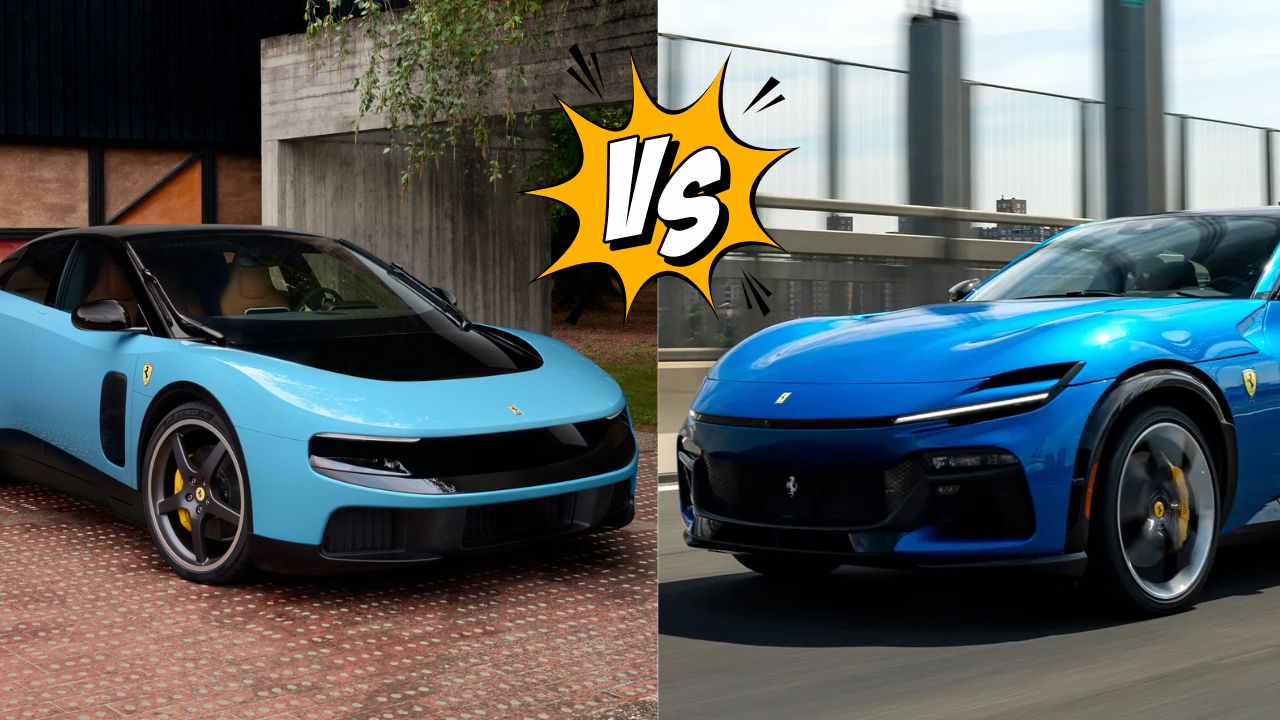
You are witnessing the most significant transition in the history of Italian performance cars. Ferrari has split its practical vehicle lineup into two entirely different directions. On one side, you have the Ferrari Purosangue. The manufacturer built this vehicle around a massive naturally aspirated V12 engine. They already launched the Purosangue in India, satisfying traditionalists who demand pure combustion noise. On the other side, you find the newly revealed Ferrari Luce. This model recently made its global debut, though the brand has not yet launched it in the Indian market. The Luce operates purely on battery power. It abandons combustion entirely to deliver extreme electric performance. You must decide if you want the established presence of a V12 powered four door model or if you prefer to wait for the technological shift the electric five seat Luce provides. The comparison between these two vehicles reveals completely different engineering philosophies. Both cars offer space for multiple passengers. Both cars deliver massive horsepower. The similarities end there.
Powertrain Engineering And Raw Performance
When you evaluate the Purosangue, you buy into the highest level of internal combustion engineering. Ferrari engineers fitted a 6.5 liter naturally aspirated V12 engine under the long front hood. This engine produces 715 brake horsepower and 716 Newton meters of torque. The power reaches all four wheels through an eight speed dual clutch transmission. The throttle response feels mechanical and immediate. You hear the engine rev to its 8,250 rpm redline. The vehicle accelerates from zero to 100 kilometers per hour in 3.3 seconds. The top speed reaches 310 kilometers per hour. You must fill the 100 liter fuel tank frequently, especially during spirited driving. The exhaust note provides a raw unfiltered sound that defines the brand.
The Ferrari Luce takes a completely different approach to speed. The vehicle utilizes four separate electric motors. Engineers placed one motor at each wheel. The total system output reaches a massive 1,035 horsepower. The front motors deliver 210 kilowatts, while the rear motors provide 620 kilowatts. The system generates 7,750 Newton meters of wheel torque. The electric propulsion allows the Luce to accelerate from zero to 100 kilometers per hour in just 2.5 seconds. You pull a specific handle in the overhead console to activate a launch mode that unlocks an additional 54 horsepower. The top speed mirrors the Purosangue at 310 kilometers per hour. The Luce relies on a 122 kilowatt hour battery pack. Ferrari uses an 800 volt architecture to allow fast charging up to 350 kilowatts. The manufacturer claims a driving range of 530 kilometers on a full charge. The electric motors operate silently. To compensate for the missing V12 sound, Ferrari installed an accelerometer on the rear axle to capture the natural frequencies of the rotating components. The system equalizes and amplifies these mechanical sounds to give you auditory feedback.
Exterior Styling And Aerodynamic Design
The exterior proportions of these two vehicles cater to different segments. The Purosangue stands tall. Ferrari refuses to call it a sport utility vehicle, but the vehicle features 185 millimeters of ground clearance and a muscular lifted stance. The vehicle measures 4,973 millimeters in length. The design incorporates an aerodynamic bridge on the front hood to channel air efficiently. The rear doors operate on a single electric hinge, swinging backward automatically when you pull the handle. The Purosangue uses 22 inch front wheels and 23 inch rear wheels. The visual weight sits low, emphasizing the aggressive haunches over the rear tires.
The Ferrari Luce sits lower and measures longer. Measuring 5,026 millimeters long and 1,999 millimeters wide, the brand classifies the Luce as an executive liftback saloon. The designers collaborated with LoveFrom to create a distinct glasshouse upper section. The front lacks a traditional grille or bonnet. A large aerodynamic wing houses the daytime running lights and channels air directly over the smooth roofline. The drag coefficient is lower than any previous road going Ferrari. The Luce also features backward opening rear doors. The vehicle sits on aerodynamically optimized turbine wheels. These wheels measure 23 inches in the front and 24 inches in the rear. The active suspension system lowers the front of the car by 10 millimeters at high speeds to reduce aerodynamic drag.
Interior Layout And Passenger Accommodation
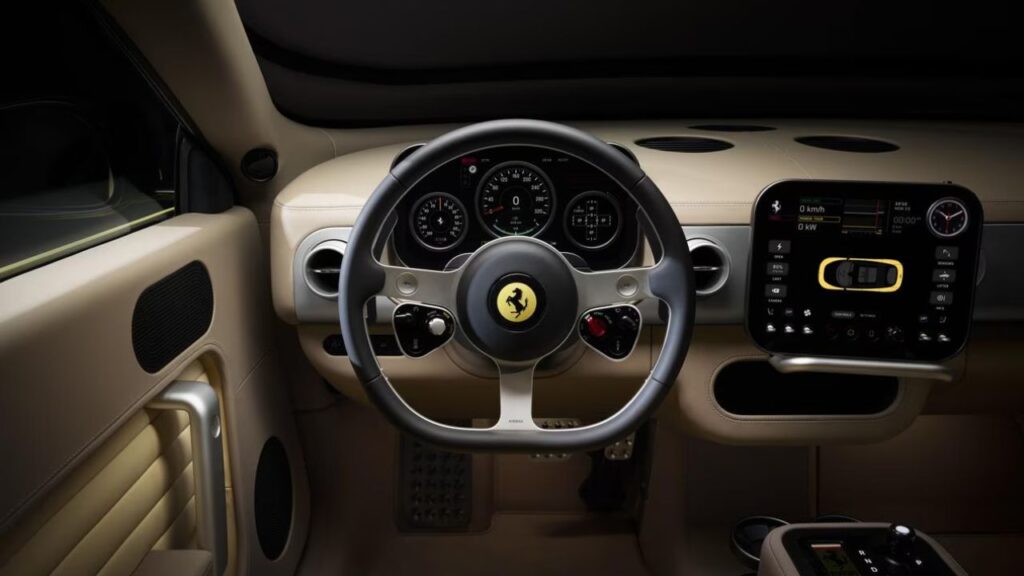
You will notice the most practical differences when you open the doors. The Purosangue provides seating for exactly four people. The cabin features four distinct bucket seats. The layout places a strong physical barrier between the rear passengers. You cannot fit a fifth person inside. The front cabin utilizes a dual cockpit design. The driver and the front passenger each get their own digital display. The dashboard completely lacks a central infotainment screen. You operate the climate and vehicle settings through a rotary dial that pops out of the dashboard. The interior uses premium leather, carbon fiber, and Alcantara.
The Ferrari Luce introduces a massive change in seating configuration. This model operates as the first production five seat vehicle in the history of the brand. You get a rear bench seat that accommodates three passengers. The flat floor provided by the electric skateboard platform creates significant legroom. The interior design rejects modern giant touchscreen panels. You operate the vehicle using physical mechanical buttons, dials, and switches constructed from glass and anodized aluminum. The steering wheel uses conventional switches instead of capacitive touchpads. The digital instrument cluster uses circular metal rings to frame the OLED displays. You control the regenerative braking and electric torque delivery using physical paddles mounted behind the steering wheel. The left paddle increases regenerative braking as you enter a corner. The right paddle applies maximum torque as you accelerate out of the turn.
Indian Market Status And Pricing Context
The availability of these two models dictates your immediate buying options. Ferrari officially launched the Purosangue in India. You can order one today if you have the financial means. The ex showroom price starts around 10.50 Crore rupees. The on road price in cities like Mumbai or Delhi reaches well beyond 11.40 Crore rupees once you factor in registration and local taxes. The Indian government applies severe taxation penalties to imported vehicles with large displacement internal combustion engines. The 6.5 liter V12 engine pushes the Purosangue into the highest possible tax bracket. You also face long waiting periods due to high global demand.
The Ferrari Luce currently exists only as a global debut. The brand unveiled the vehicle in Rome but has not yet confirmed an official launch date for the Indian market. The first European deliveries will begin in late 2026. The United States market receives the car in 2027. You can expect the Indian launch to happen in late 2027 or early 2028. The European pricing starts at 550,000 euros. When the vehicle eventually arrives in India, the price structure will look different from the Purosangue. Electric vehicles imported as completely built units face slightly different rules. While the basic customs duty remains high, the goods and services tax on electric vehicles in India sits at just 5 percent. This massive difference could bring the final on road price of the Luce closer to the Purosangue, despite the extreme performance figures. You must consider the charging infrastructure in India before planning long road trips with the Luce. Finding a reliable 350 kilowatt direct current fast charger outside major metropolitan areas remains difficult.
Technical Specifications Comparison
You can compare the specific mechanical and physical attributes of both vehicles below. The numbers reveal the exact differences between the electric and combustion platforms.
| Specification | Ferrari Purosangue | Ferrari Luce |
| Powertrain Type | 6.5 Liter V12 Naturally Aspirated | Quad Motor Electric |
| Total Power Output | 715 Horsepower | 1,035 Horsepower |
| Acceleration Zero to 100 km/h | 3.3 Seconds | 2.5 Seconds |
| Top Speed | 310 km/h | 310 km/h |
| Seating Capacity | 4 Passengers | 5 Passengers |
| Body Style | Four Door Crossover | Five Door Liftback Saloon |
| Overall Length | 4,973 millimeters | 5,026 millimeters |
| India Availability | Launched and Available | Global Debut Only |
Key Distinctions For Buyers
Reviewing these specific factors helps clarify which vehicle fits your lifestyle and driving preferences.
- Engine Sound Profile: You buy the Purosangue to hear the authentic mechanical scream of a naturally aspirated V12 engine. You wait for the Luce if you prefer silent electric running with synthesized mechanical amplification.
- Passenger Capacity: You choose the Luce if you require a middle seat in the rear for a fifth passenger. You buy the Purosangue if you only need transport for four people in separate bucket seats.
- Fuel And Charging: You select the Purosangue for cross country travel where fuel stations are common. You pick the Luce for city driving and routes with established fast charging networks.
- Acquisition Timeline: You purchase the Purosangue if you want a vehicle delivered within the current production cycle in India. You must wait an undefined period for the Luce to officially reach the Indian market.
- Interior Interaction: You get the Luce to experience mechanical glass dials and physical buttons. You get the Purosangue for a dual cockpit design separated by a physical console.
Engineering Philosophy And Handling Dynamics
Ferrari engineered the chassis of both cars to handle immense weight and power. The Purosangue utilizes a transaxle layout. The engine sits behind the front axle, and the gearbox sits at the rear. This setup gives the vehicle a 49 to 51 weight distribution. The active suspension uses True Active Spool Valve technology. Electric motors inside the shock absorbers actively push the wheels into the ground to eliminate body roll. You can throw the heavy Purosangue into tight corners, and the vehicle remains completely flat. The all wheel drive system disconnects the front wheels at high speeds to improve efficiency and provide a traditional rear wheel drive feel.
The Luce uses a dedicated electric vehicle platform. The heavy 122 kilowatt hour battery sits low in the floor, dropping the center of gravity far below the Purosangue. The vehicle weighs 2,260 kilograms. The active suspension works with a new vehicle control unit that updates parameters 200 times per second. The four independent electric motors allow true torque vectoring. The system can send specific amounts of power to individual wheels to push the car through corners. The four wheel steering system turns the rear wheels to increase agility at low speeds and improve stability during high speed lane changes. The engineers designed a separate elastically mounted subframe to isolate the cabin from road vibrations.
The Final Decision
Your choice between the Ferrari Purosangue and the Ferrari Luce depends on what you value in a performance vehicle. The Purosangue offers immediate gratification in the Indian market. It delivers the classic Ferrari V12 experience contained in a highly practical four door body. You get the loud exhaust, the mechanical gear shifts, and the ability to refuel anywhere. It represents the absolute limit of combustion engine development.
The Luce asks for your patience. You must wait for its official Indian launch. It forces you to abandon the traditional V12 sound and adapt to electric charging infrastructure. In return, the Luce gives you significantly more power, faster acceleration, and the ability to carry five people. The physical dials and tactile interior materials prove that an electric vehicle does not need to feel like a computer. You must decide if you want to buy the ultimate version of the past or reserve the fastest version of the future.